Implant-free breast aesthetics can lift and reshape the breast using existing tissue, offering another route to natural-looking upper-pole fullness.
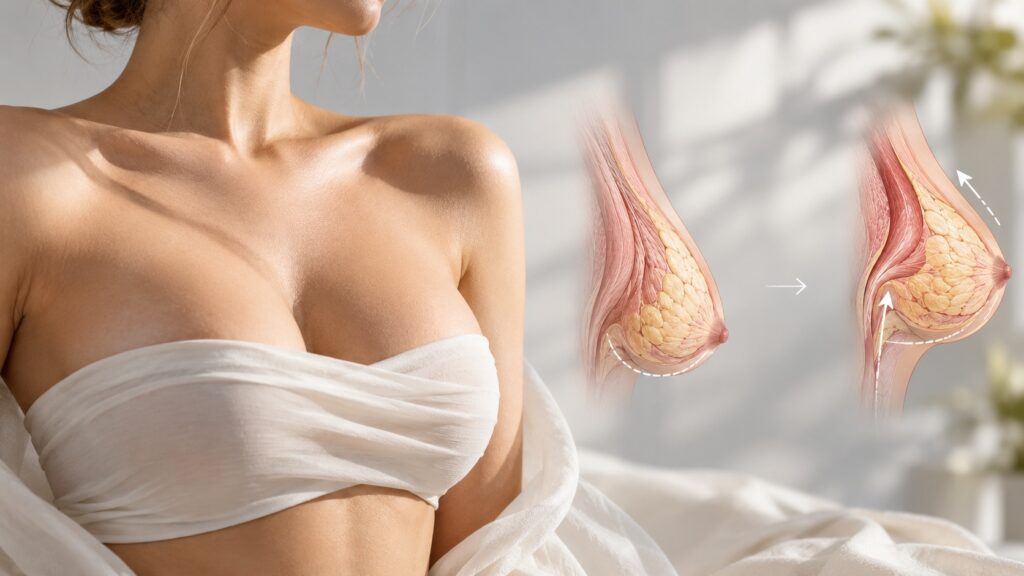
For someone considering breast aesthetics, the starting question is not always, “Which implant should I choose?” Some patients want a lifted shape and more fullness but would prefer not to have silicone or another foreign material placed in the breast. In those cases, the conversation takes a different direction.
Modern mastopexy and autoaugmentation techniques can, in selected patients, make use of breast tissue that is already there. Rather than introducing volume from outside the body, the surgeon reshapes and repositions existing tissue. That distinction matters: these procedures are not simply “breast augmentation without an implant.” They have their own goals, limitations and suitability criteria.
Table of Contents
What Is Implant-Free Breast Aesthetics?
Implant-free breast aesthetics is a broad term for surgical approaches that reshape or enhance the breast without inserting a breast implant. Depending on the patient’s anatomy, the procedure may involve lifting sagging tissue, redistributing existing breast volume or using an autologous tissue flap to improve projection and upper-pole contour.
The main difference is straightforward. A conventional breast implant introduces a predetermined amount of additional volume. An implant-free technique has to work with the volume the patient already has. The amount, distribution and quality of natural breast tissue therefore have a direct influence on what can realistically be achieved.
For a patient whose main concern is breast ptosis, loss of upper-pole fullness or a deflated appearance after pregnancy or weight change, reshaping existing tissue may be one of the options worth discussing alongside more familiar procedures.
Breast Lift and Breast Augmentation Are Not the Same Thing
A breast lift, or mastopexy, is primarily about position and shape. Excess skin may be removed, the breast envelope reshaped and, where appropriate, the nipple-areola complex repositioned. Breast augmentation has a different primary purpose: adding volume, most commonly through an implant or fat transfer.
In practice, though, aesthetic goals do overlap. Someone asking for “more fullness” may not necessarily need substantially more breast volume. What bothers her may be where that existing volume sits. This is why an anatomical assessment tells far more than choosing a procedure based on its name.
Autoaugmentation sits somewhere between these concepts. Surgical literature describes techniques in which an inferiorly based dermoglandular or parenchymal flap is repositioned during mastopexy to improve projection and upper-pole fullness without introducing an implant.
What Is Autoprosthesis and How Does It Work?
Autoprosthesis is the concept of using the patient’s own breast tissue as a source of internal volume and structural shaping. Put simply, tissue already present in the breast is strategically repositioned instead of being replaced or supplemented by an artificial prosthesis.
The aim is not necessarily to make the breast dramatically larger. Available tissue can instead be redistributed from an area with sufficient volume toward an area where more projection or fullness is wanted. It sounds like a subtle distinction, but clinically and aesthetically it changes what the procedure is designed to accomplish.
Using the Breast’s Own Tissue
During breast autoaugmentation, natural tissue can be fashioned into a flap while maintaining the blood supply needed for the tissue to remain viable. That flap is then repositioned as part of the reshaping procedure.
For a patient, perhaps the simplest way to picture the idea is as a redistribution of existing volume. A separate silicone device is not creating the shape; the patient’s own breast tissue is being used in a different position.
Why Is Upper-Pole Fullness Important?
The upper pole is the part of the breast above the nipple. When volume in this area decreases, the breast can take on the empty or deflated appearance some patients notice after pregnancy, breastfeeding, significant weight loss or age-related change.
A conventional mastopexy can lift the breast, but creating and maintaining upper-pole fullness has long been discussed as one of the challenges of breast reshaping surgery. Autologous tissue techniques approach that problem by repositioning available tissue so that it contributes more to the contour of the upper breast.
What Is the Dual-Plane Autoprosthesis Approach?
Dual-Plane Autoprosthesis is a particular variation of the broader autoprosthesis concept. Instead of relying solely on folding or rearranging glandular tissue within the breast, this approach uses two anatomical planes and places an inferior dermoglandular pedicle in the subpectoral plane.
In less technical terms, suitable tissue from the lower part of the breast is preserved, reshaped and repositioned beneath the pectoralis major muscle. The objective is to use the patient’s own living tissue to create internal volume, projection and support in the upper pole.
The muscle has a structural function here. Tissue is not merely shifted upward; it is placed in an anatomical position where muscular support can contribute to its projection and stability.
How Is This Different From a Conventional Autoprosthesis?
Autoprosthesis does not refer to one universally standardized operation. Over time, surgeons have described different flap designs, fixation techniques and ways of rearranging breast tissue.
What separates the dual-plane concept is the subpectoral positioning of autologous tissue. That technical detail matters. It also explains why Dual-Plane Autoprosthesis should not simply be treated as another name for every implant-free mastopexy or autoaugmentation technique.
Why Do Some Patients Look for Breast Aesthetics Without Implants?
There is no single reason. Some patients simply feel more comfortable with the idea of using their own tissue. Others may be concerned about implant-specific issues such as capsular contracture, rupture or the possibility of needing implant-related surgery later.
That does not mean an implant is inherently the wrong choice. For another patient, an implant may provide the volume, projection or shape that more closely matches what she wants. The useful question is not whether one approach is universally better; it is whether the desired result can realistically be produced from the tissue available.
No Foreign Material Does Not Mean No Surgical Risk
An implant-free procedure avoids complications that specifically depend on the presence of a breast implant. It is still surgery, however. Scarring, healing problems, asymmetry, changes in sensation, infection, tissue-related complications and the possibility of revision can still be relevant, depending on the operation and the individual patient.
So “no implant” should not be read as “no risk.” The potential benefits, limitations and complications need to be discussed with a qualified plastic surgeon in the context of the patient’s health and anatomy.
Who May Be a Candidate for Implant-Free Breast Reshaping?
Patient selection matters particularly with these procedures because the surgeon is working with tissue that already exists. A patient with breast ptosis and enough natural volume starts from a very different position than someone who wants a substantial increase in breast size but has relatively little existing tissue.
A surgeon may consider factors such as:
- The degree of breast ptosis or sagging
- The amount of existing breast tissue
- Tissue quality and distribution
- Loss of upper-pole fullness
- Previous breast surgery
- Skin quality and elasticity
- The patient’s desired breast size, projection and shape
- Whether avoiding an implant is an important personal preference
This is one reason before-and-after photographs from another patient have their limits. Two people may both be looking for a “natural breast lift” and still have quite different starting anatomy. Their realistic surgical outcomes can be different too.
Implant vs. Implant-Free Breast Aesthetics: What Actually Changes?
The clearest distinction is the source of volume. An implant introduces additional volume into the breast. An autoprosthesis or autoaugmentation technique redistributes tissue the patient already has.
| Consideration | Implant-Based Approach | Autologous Autoaugmentation Approach |
|---|---|---|
| Primary volume source | Breast implant | Existing breast tissue |
| Foreign implant material | Yes | No breast implant |
| Dependence on existing tissue | Lower for added volume | Higher |
| Potential for major size increase | Generally greater | Limited by available tissue |
| Upper-pole contour | Influenced by implant selection and placement | Created through tissue redistribution and shaping |
| Implant-specific complications | Possible | Avoided because no implant is present |
This is not a scorecard between two competing procedures. They address somewhat different problems. Ptosis, available volume, previous operations and the shape a patient hopes to achieve all influence which approaches can reasonably be considered.
How Does Natural Tissue Affect the Look and Feel?
The appeal of own-tissue breast reshaping is easy to understand: the volume being repositioned is already part of the breast. There is no separate prosthetic device determining the feel of that volume.
Still, “natural-looking” is subjective. Breast width, skin quality, tissue density, chest anatomy, scars and the amount of available tissue can all affect the final appearance. A consultation is more useful when it focuses on achievable proportions rather than promising a particular look.
Longevity deserves the same realistic approach. Breast tissue continues to respond to ageing, gravity, pregnancy and weight fluctuations after surgery. No mastopexy technique permanently fixes the breast in its postoperative position.
PureOwn and the Zereyak Autoprosthesis Approach
Within this field, pureown focuses on the Zereyak Autoprosthesis and its Dual-Plane Autoprosthesis technique. The method uses an inferior dermoglandular pedicle repositioned into the subpectoral plane, with the aim of creating upper-pole support and projection without a silicone breast implant.
The technique was developed by plastic surgeon Op. Dr. Umut Zereyak and has been described in aesthetic breast surgery literature. PureOwn presents the approach for patients researching own-tissue breast reshaping, while considering factors such as existing breast volume, ptosis and individual aesthetic goals when assessing suitability.
That specificity is useful when researching implant-free surgery. “No implant” describes a broad category. A named surgical technique, on the other hand, gives the patient more information about how the tissue is actually rearranged and supported.
What Does the Scientific Literature Say About Autoaugmentation?
Autologous breast reshaping itself is not a new concept. Published studies have described inferior-pedicle and other parenchymal flap techniques intended to improve breast projection and upper-pole fullness during mastopexy.
Clinical series have reported favorable aesthetic outcomes and patient satisfaction. The evidence is not uniform, though: techniques, study populations and follow-up periods vary. Comparative research also helps explain why expectations need to stay realistic. Implant-based augmentation can produce different upper-pole characteristics from autoaugmentation even when satisfactory outcomes are reported with both approaches.
Autoaugmentation therefore has an established place within the broader field of aesthetic breast surgery, but individual techniques should not be treated as interchangeable. Larger studies and longer follow-up remain useful, particularly when newer technical variations are being evaluated.
What Should You Ask During a Consultation?
If you are considering Implant-Free Breast Aesthetics, knowing the name of the procedure is not enough. A useful consultation should leave you understanding what will happen to your own tissue, what the operation can realistically change and, just as importantly, what it cannot.
Questions worth asking include:
- Do I have enough natural breast tissue for autoaugmentation?
- How much upper-pole fullness can realistically be created in my case?
- Will this technique change my breast size or mainly its shape and position?
- Where will the tissue be repositioned?
- What scars should I expect?
- What are the procedure-specific risks and possible complications?
- How might pregnancy, ageing or weight changes affect my result?
- What alternatives would better suit me if my existing tissue is insufficient?
One question is particularly useful: why does this technique fit my anatomy? Choosing a procedure because it sounds newer or more appealing tells you very little. Matching the method to the patient’s anatomy and goals is what matters.
Frequently Asked Questions About Implant-Free Breast Aesthetics
1. Can breasts be made fuller without implants?
Yes, in selected patients. Existing breast tissue can be redistributed to improve projection and upper-pole fullness. How much change is possible depends on the amount and quality of available tissue, so an own-tissue technique cannot be assumed to reproduce every degree of volume increase achievable with an implant.
2. Is an autoprosthesis actually a breast implant?
No. Despite the word “prosthesis,” an autoprosthesis in this context is formed from the patient’s own tissue. The term describes tissue being shaped and repositioned to provide volume or internal support rather than the insertion of a silicone breast implant.
3. Is Autoprosthesis the same as a breast lift?
Not exactly. Mastopexy means lifting and reshaping a sagging breast. Autoprosthesis or autoaugmentation techniques may be incorporated into a mastopexy so that existing tissue is redistributed to address projection or upper-pole fullness at the same time.
4. Can implant-free surgery increase breast size?
Only to the extent allowed by the patient’s existing tissue. Redistribution can make the upper breast appear fuller and alter projection, but it does not add a new source of volume in the way a breast implant does. The realistic degree of change varies from patient to patient.
5. What does “Noimplant” breast aesthetics mean?
Noimplant generally refers to a preference or surgical approach in which breast shape is improved without inserting a breast implant. Depending on the procedure, this may involve mastopexy, tissue rearrangement, autoaugmentation or other autologous strategies.
6. What is upper-pole fullness?
Upper-pole fullness is the volume and contour of the breast above the nipple. Pregnancy, weight loss and ageing can reduce fullness in this area. Implant-based and own-tissue procedures may both address the upper pole, although they achieve that change in different ways.
7. Can everyone have a Dual-Plane Autoprosthesis?
No. Suitable existing breast tissue and appropriate anatomy are necessary. Degree of ptosis, tissue volume and quality, previous surgery, general health and the result a patient wants all need to be assessed by a qualified plastic surgeon before suitability can be determined.
8. Does implant-free breast surgery leave scars?
Yes, it can. Avoiding a breast implant does not mean avoiding surgical incisions. The expected scar pattern depends largely on the mastopexy and reshaping technique, the degree of ptosis and how much skin needs to be addressed.
9. Are the results of an implant-free breast lift permanent?
No breast lift remains permanently unchanged. Surgical reshaping can provide a long-lasting improvement, but natural breast tissue continues to age. Gravity, pregnancy, hormonal changes and significant weight fluctuations may alter breast shape over time.
10. What happens if there is not enough natural breast tissue?
If the available tissue cannot provide the volume or projection needed for the patient’s goals, an autoprosthesis approach may not be suitable. A surgeon may instead discuss options such as conventional mastopexy, fat transfer, an implant or a combination of techniques, depending on the individual case.
11. Does avoiding an implant make breast surgery risk-free?
No. It avoids risks that specifically arise from having an implant, but surgical and tissue-related risks remain. The relevant complications, recovery process and possibility of revision depend on the procedure and the individual patient.
12. How should I choose between an implant and my own tissue?
Start with the result you want, not the name of a procedure. Desired size and upper-pole projection, existing breast volume, degree of sagging and whether you are comfortable having an implant all matter. A specialist assessment can then determine which options realistically fit those goals.
What is your reaction to this?
 I liked it
 Wonderful
 Thanks
 Good
Good Hahaha !
 Incredible
 Interesting
 Wrong
Wrong